
Technologies:
React Native, React, Ruby On Rails, AWS
AWS Services:
EC2, ECS, RDS, S3, IoT Core, Route 53, API Gateway, CloudFront, Lambda
The Client
DCloud is a multi-tenant platform by DTI for machine coordination, operations, and fleet management in the food & beverage sector. The platform communicates with thousands of devices via the MQTT protocol, allowing operators to view data and send commands to active devices deployed in the field.
The Challenge
The customer needed to evolve their MVP for machine telemetry boards into a platform ready for commercialization in the food & beverage sector, supported by a qualified technical team.
Solution
After an initial analysis of the codebase, we structured the work around the client’s needs and the main pain points identified, and then started refactoring the project.
Our goal was to transform DCloud’s MVP into a multi-tenant SaaS: a cloud software architecture based on a single application instance capable of serving multiple customers (tenants), keeping them logically isolated and operating with tenant-specific protocols, while sharing the same core resources. This approach ensured efficiency, scalability, and cost reduction.
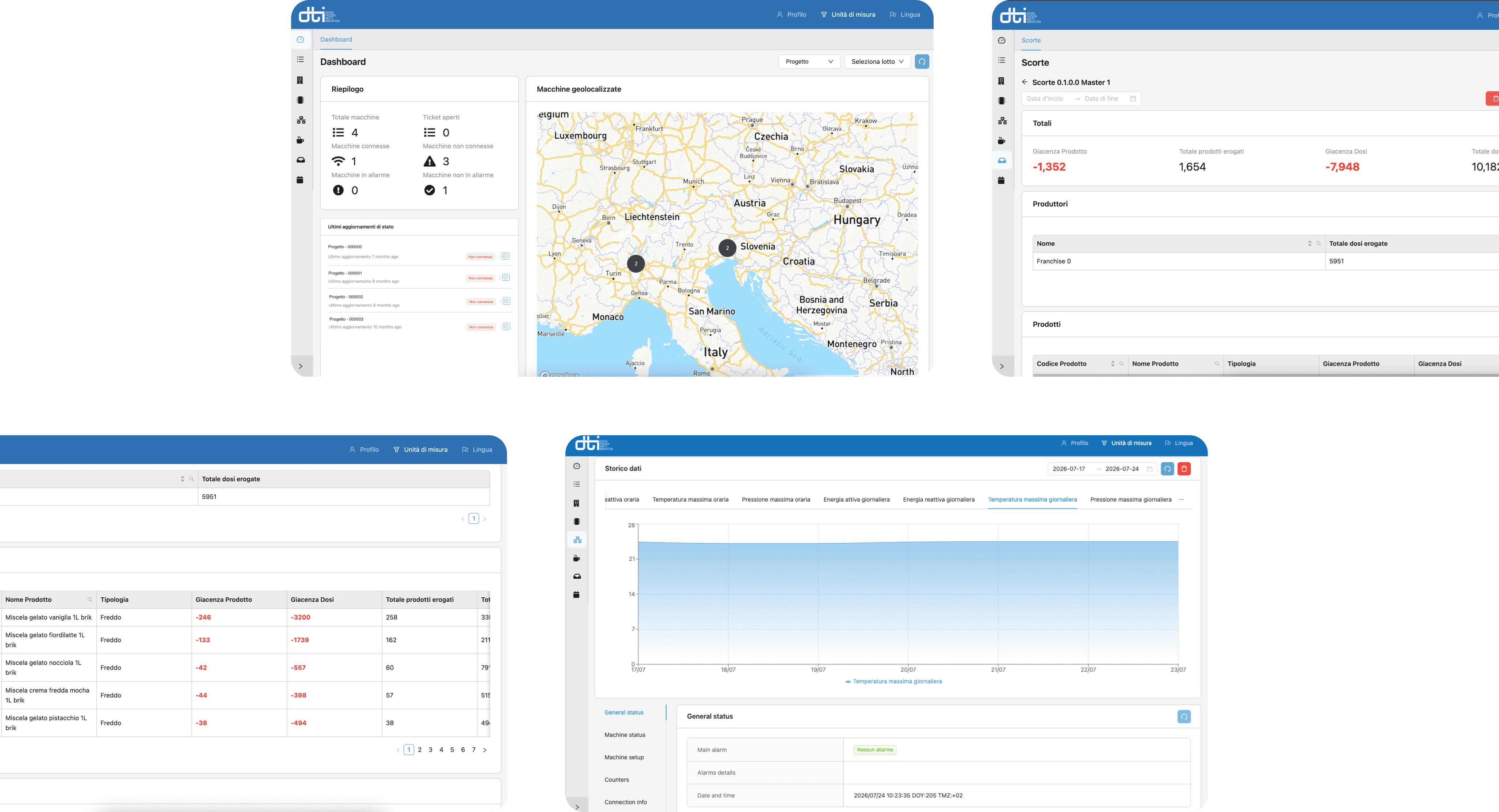
We worked to make DCloud a core tool for collecting data from machine control boards, enabling data aggregation and forecasting. The platform includes a dashboard that clearly displays consumption, alerts, maintenance activities, inventory levels, and other key operational data.
In addition, we developed an application used by field operators that communicates continuously with the cloud platform and allows them to manage refilling and maintenance requests.
Today, DCloud can notify tenants when a service request is generated (on-site or remote) by automatically opening a ticket. For on-site service activities, we also integrated a fleet management module that intelligently plans technicians’ routes to execute maintenance operations in the most efficient way possible.
MQTT Communication
Through provisioning, the app and the cloud platform communicate continuously in a bidirectional manner. For each tenant, tenant-specific MQTT communication protocols are defined, within which the relevant machines are registered to send telemetry data, receive commands, and synchronize their status.
Data Aggregation & Forecasting
Machine data is synchronized and organized by the cloud platform to perform periodic analyses. Based on this data, the system can generate forecasts related to inventory usage, maintenance frequency, and the identification of patterns and operational strategies.
Multi-Tenancy
DCloud follows a parent–child hierarchy, where each customer can in turn manage sub-customers. Each level defines the permissions of its child levels, specifying what can be viewed or modified. This model enables granular permission control while maintaining operational consistency, even across complex customer and sub-customer networks.
Stock & Supplies
The cloud platform communicates with the associated app to monitor the inventory level of each machine that uses consumables (e.g. water, beverage powders, blister packs, etc.). Operators scan the machine’s QR code, access the loading history, and record new refills by specifying date, quantity, and product type. Once operations are completed, maintenance technicians update the machine status via the app, which simultaneously sends the data to the cloud platform.
Machine Maintenance Tracking
When a machine’s status changes or predefined protocol rules are triggered, an alert system activates and opens a ticket for the required maintenance activity. Maintenance tracking and tickets can be managed for each machine, monitoring every intervention until full resolution, both from the app and from the cloud platform.
Fleet Management
We also implemented and optimized maintenance fleet management. DCloud calculates technicians’ routes based on the geographical distance between machines requiring service. For each route, distance and travel time are calculated to allow technicians to reach service locations in the most efficient way possible.
Do you have a project in mind?