
Technologies:
Laravel, AWS
AWS Services:
EC2, ECS, RDS, Route53, CloudFront, Lambda, Elastic Load Balancing
The Client
MCZ Group is a leading player in the biomass heating sector, offering fireplaces, stoves, range cookers, barbecues and other domestic fire appliances throughout Europe.
Leveraging the Group's extensive network of brands, distribution channels, and commercial strategies, the company serves a wide range of markets.
The Challenge
The MCZ Group had two main requirements: to optimize the company website by refactoring the AWS architecture and to support the Cloud infrastructure of the new portal for the B2B-only area (already hosted on AWS) to achieve better performance and high reliability. In addition, we focused on Cloud resource management from a FinOps perspective.
Solution
We conducted an in-depth analysis of MCZ’s infrastructure, which had previously undergone a Lift-and-Shift migration, in orderWe conducted an in-depth analysis of MCZ’s infrastructure, which had previously undergone a Lift-and-Shift migration, in order to define the most effective optimization strategy.
During the refactoring process, we containerized the code and website components in order to isolate them within a single environment that is easily deployable and portable.
By configuring the environment for high availability (HA), we ensured continuous application availability.
At the same time, we carried out FinOps activities to optimize the use of Cloud resources and reduce the costs associated with the previous Lift-and-Shift migration.
MCZ now has a more flexible environment that better aligns with actual workload requirements at a significantly lower cost.
Replatforming and refactoring
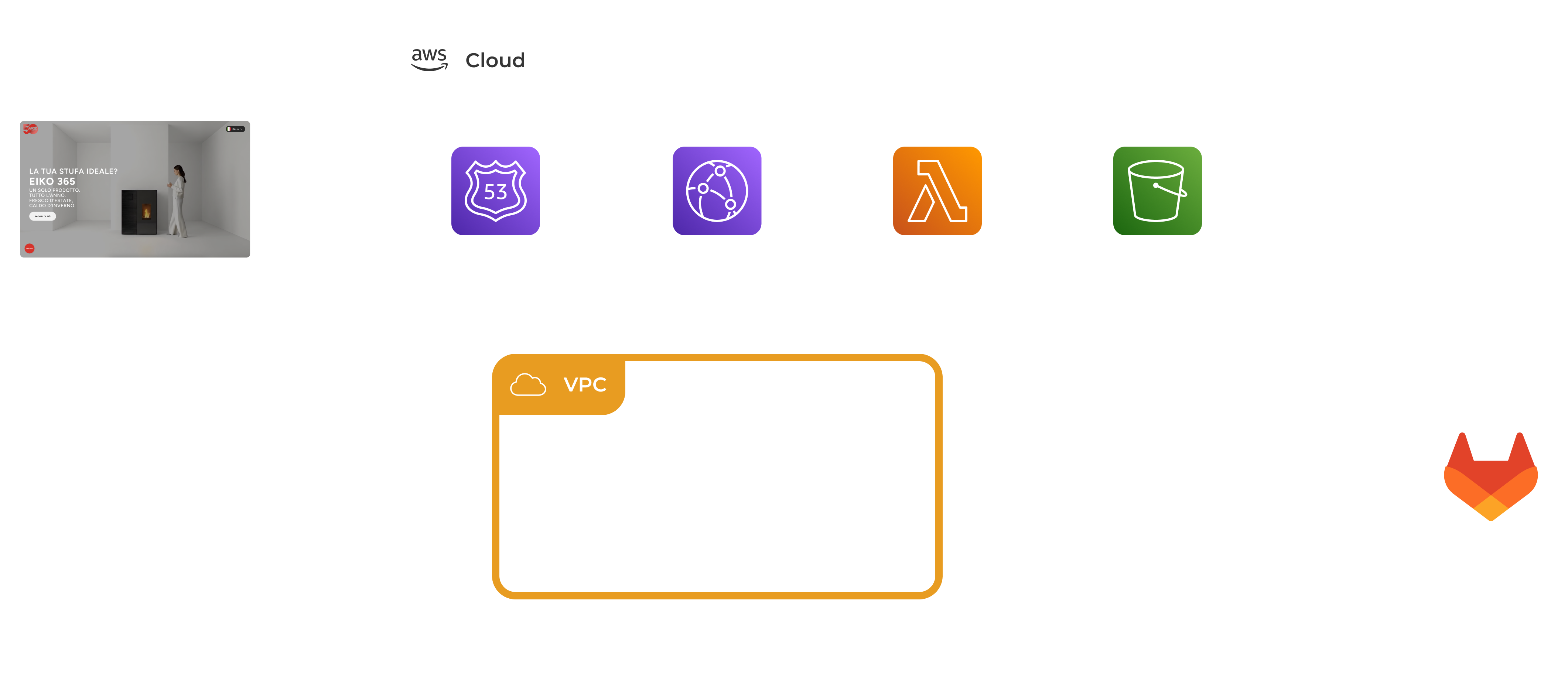
The infrastructure was migrated to AWS to achieve greater stability and flexibility. At the same time, the code had to be rewritten to decompose the MCZ monolith by containerizing each module separately. Now, each module scales independently based on demand, optimizing overall performance, reducing operating costs, and eliminating downtime.
Separation of layers using RDS and S3
The monolith was decomposed by separating the application layer from the persistence layer, with persistence now handled using Amazon RDS and S3. The goal was to isolate state from the application, eliminating the co-location constraints on the same server. Performance improves thanks to dedicated resources that scale independently, while costs are reduced by paying only for actual compute and storage usage. Furthermore, the new architecture ensures a fine-grained security model and enhanced resilience, relying on automatic backup strategies that are independent of the application’s lifecycle.
CDN Management
Amazon CloudFront provides a critical security layer for the architecture. As a CDN, it caches static content stored in S3 (such as images and PDFs), at global edge locations, minimizing load times for users. At the same time, it intercepts and blocks cyberattacks, such as DDoS attacks, directly at the perimeter, before they can impact the internal infrastructure. This protection not only secures the application but also optimizes overall cloud costs by preventing unnecessary or malicious traffic from overloading the core application containers and the database.
High Availability with Load Balancer and Autoscaling
The Load Balancer efficiently distributes traffic across containerized modules, handling failures and routing users only to healthy instances. Auto Scaling adjusts the infrastructure in real time, responding to traffic spikes and using only the resources required.
ECS Orchestration
ECS transforms MCZ’s isolated software components into a single, cohesive and resilient system, without manual intervention. The system decides where and when to run containers, optimizing AWS resource utilization. It ensures self-healing by instantly replacing a failed container, and coordinates updates with zero downtime, rolling out new features in the background while users continue browsing the site.
CI/CD Pipeline
With Continuous Integration (CI), every time the code is modified, the system automatically builds a new container image and runs rigorous tests to detect bugs and prevent regressions before release. Once the tests are passed, Continuous Deployment (CD) deploys the updated service to Amazon ECS, which updates it with zero downtime. This simplifies the release of changes, fixes, and new features on MCZ, eliminating the need for manual intervention or service interruptions.
Do you have a project in mind?